
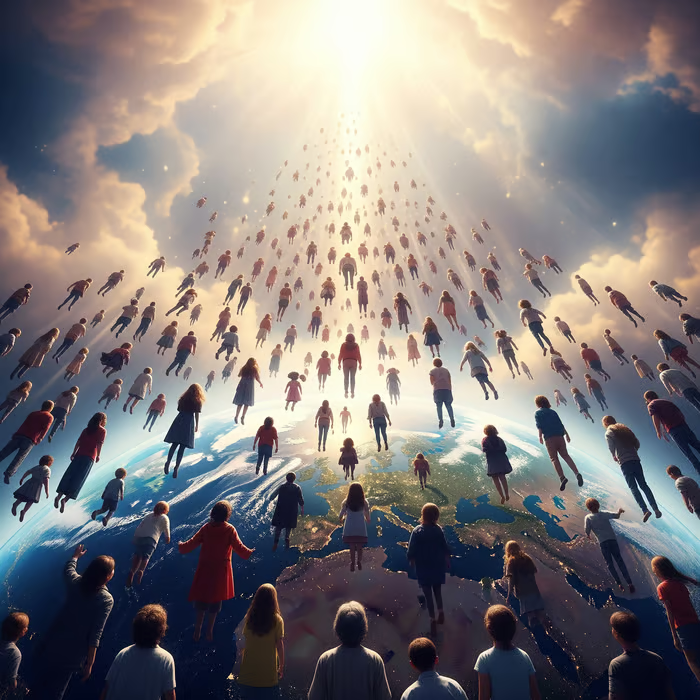

With a Subtitle: So let's take another look at Predestination vs. Free-Will.
A brief Excerpt: So let's take another look at Predestination vs. Free-Will.
Quote Source – Medium Reader
A Biblical Christian worldview perspective – The full context of his comment was …
“Scripture clearly states that God desires to save all people. How do you reconcile that with predestination? Don’t 1 Timothy 2:3-4 and 2 Peter 3:9 establish free will as a person can reject God ? Also, I think of the parable of the sower and the seeds which seems to say people have a choice. Thanks for your insight.”
1 Timothy 2:3-4 - This is good, and it is pleasing in the sight of God our Savior, who desires all people to be saved and to come to the knowledge of the truth.
2 Peter 3:9 - The Lord is not slow to fulfill his promise as some count slowness, but is patient toward you, not wishing that any should perish, but that all should reach repentance.
My Response
To begin with, predestination (vs. Free-Will) should not be part of the Core Theology of a Biblical Christian. So, I offer an opinion, but certainly could be wrong.
I do believe mankind has some form of free will or there would be little need of a Bible (an instruction manual for Life). However, in the case of salvation, I think that God not only has foreknowledge but does predestine those He has chosen before the foundations of the world (Ephesians 1:4).
Of course, from a human perspective, we have no idea who the saved will be, so we need to be available, building relationships with all who will listen.
This free-will / predestination controversy over salvation has raged for hundreds of years. The reason is that there are verses on both sides of the theological coin.
As counterpoints to the Scripture you offer …
Romans 8:29-30 - For those whom he foreknew he also predestined to be conformed to the image of his Son, in order that he might be the firstborn among many brothers. And those whom he predestined he also called, and those whom he called he also justified, and those whom he justified he also glorified.
John 6:44 - No one can come to me unless the Father who sent me draws him. And I will raise him up on the last day.
Ephesians 1:4-5 - even as he chose us in him before the foundation of the world, that we should be holy and blameless before him. In love he predestined us for adoption as sons through Jesus Christ, according to the purpose of his will.
Matthew 24:22,31 - And if those days had not been cut short, no human being would be saved. But for the sake of the elect those days will be cut short... And he will send out his angels with a loud trumpet call, and they will gather his elect from the four winds, from one end of heaven to the other.
Mark 13:20,27 - And if the Lord had not cut short the days, no human being would be saved. But for the sake of the elect, whom he chose, he shortened the days....And then he will send out the angels and gather his elect from the four winds, from the ends of the earth to the ends of heaven.
Romans 8:33 - Who shall bring any charge against God’s elect? It is God who justifies.
Romans 9:11 - though they were not yet born and had done nothing either good or bad—in order that God’s purpose of election might continue, not because of works but because of him who calls.
Others verses include … Romans 11:5-7,28, Ephesians 1:11, Colossians 3:12, 1 Thessalonians 1:4, 2 Timothy 2:10, Titus 1:1, 1 Peter 1:1-2 (foreknowledge) , 2 Peter 1:10.
However, to be clear, this is never a matter of dueling verses in order to see who has the greater number in his court. Instead, we need to see the Bible as a unified document from God such that, to the best of our poor abilities, verses need to be reconciled to form a systematic theology. My perhaps shallow way of doing that in this case is to say:
- God is outside of time,
- God knows the history of each of us from birth to death, before we were even born,
- Therefore, God knows, in advance, who would come to Him and who would not, if given free will,
- That knowledge is “foreknowledge,”
- God desires that “all will come to Him” but knows that will not happen based on verses such as Ephesians 2:1, John 6:44, to some degree Romans 1:19-20),
- So, by some criteria we are not given insight into, God, in order to “save some” by way of the “narrow gate” vs. the “wide gate” (Matthew 7:13-14) decided in eternity past who He would draw to Himself.
We can get all tangled up in theology on God’s permissive vs sovereign will but the bottom line is, the formula for who comes to Christ and who does not is, I believe, (though I could be wrong), exclusively in the hand of the Lord. I recognize this seems arbitrary and unloving by those who are lost. However, it should not be a cause for rejecting the importance of evangelism since we, as humans, have no idea who will be saved and who will not (regardless of the mechanism employed, i.e. predestination or free-will).
What is unquestioned from Scripture is that without God’s grace in providing Christ as a substitutionary sacrifice for our sins, no one would go to Heaven. Part of the faith of a Biblical Christian is in trusting that we will more clearly understand all things, including the fairness of God’s plan of salvation, on the other side of the grave (1 Corinthians 13:12).
Salvation – Eternal Life in Less Than 150 Words
Please Comment – here or on Medium