

Subtitle: The plagues serve as a reminder that true stability, life, and protection come from God, not from external sources or false dependencies.
Excerpt: The plagues serve as a reminder that true stability, life, and protection come from God, not from external sources or false dependencies.
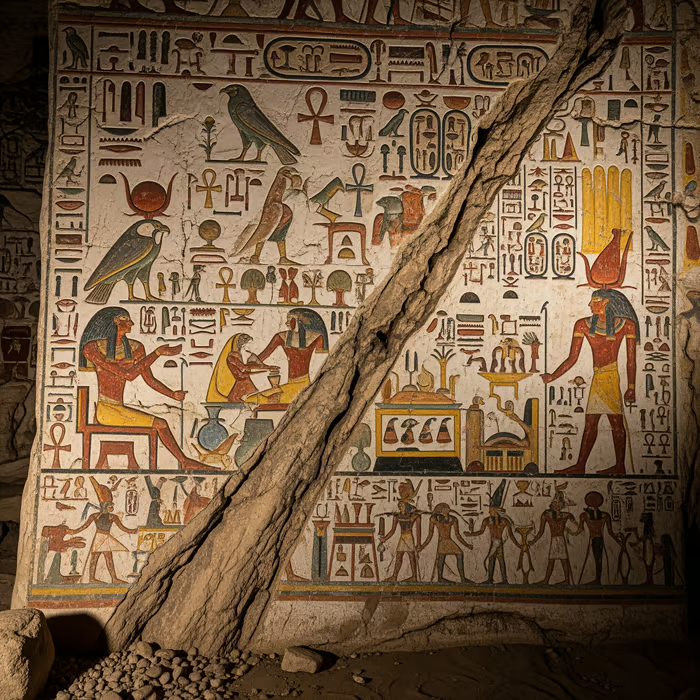
God has a sense of humor, and I will prove it. The ten plagues of Egypt are related to 10 of the main gods of that time. By sending these specific plagues, God was confronting and mocking the Egyptian gods, destabilizing their “powers” and symbols. Let’s look in more detail at each plague and its corresponding Egyptian god.
1. First Plague: Water Turned into Blood (Exodus 7:14–25)
The first plague is the turning of the water from the Nile River into blood. This plague destroys the water resources, killing the fish and preventing access to drinking water, while also attacking a central element of Egyptian culture. The Nile was a symbol of life, fertility, prosperity, and connection to the divine. It was sacred to the Egyptians.
The god of the Nile, Hapi, and Osiris, who was also associated with the river and its cycle of life and death, are challenged. The Nile was considered the “flow of life” for the country. Transforming it into blood symbolized a direct interruption of this vital flow, showing the vulnerability of the Egyptian gods before God’s power.
What we can learn:
- Recognizing False Dependencies: In our lives, we may be tempted to depend on external sources like our careers, material possessions, or other “sources of life.” This first plague reminds us that true stability and life come from God (Matthew 7:24–27). Let’s examine our lives to identify any dependency that might be taking the place that only God should have, and focus on trusting Him as our ultimate source of all we need.
2. Second Plague: Frogs (Exodus 8:1–15)
The second plague is the invasion of frogs, filling every living space. While frogs often represent fertility and regeneration in many cultures, in uncontrolled abundance, they bring chaos.
This plague directly challenges Heket, the goddess of fertility and childbirth, who was depicted with the head of a frog. For the Egyptians, Heket symbolized renewal and life. But in this case, the frogs become an uncontrollable nuisance, invading all areas of daily life. By turning frogs, a symbol of fertility, into a plague, God shows that uncontrolled abundance leads to chaos and that Heket has no real power over creation or the balance of life.
What we can learn:
- Balancing Blessings and Excess: Like the frogs, certain things in our lives — work, technology, or entertainment — can be good in moderation, but when taken to excess, they bring chaos. This plague invites us to reflect on maintaining balance and to ensure that everything in our life is in the right place and under God’s guidance. Seeking a healthy balance helps us enjoy blessings without letting them become burdens (Ecclesiastes 7:16).
3. Third Plague: Gnats (or Mosquitoes) (Exodus 8:16–19)
The third plague turns the dust of the earth into lice, or possibly mosquitoes, affecting both people and animals. These insects are hard to kill and cause irritation and disease.
This plague challenges Geb, the god of the earth, and the fertility of the soil. For the Egyptians, the dust of the earth was a symbol of life and fertility, as it supported plants and animals. By transforming the dust into a source of discomfort and disease, God shows that even the fundamental element of the earth, supposedly under the protection of Geb, can become an instrument of suffering.
What we can learn:
- God Has Power Over All Circumstances: We may face health issues, conflicts, or difficulties in relationships and sometimes rely on our abilities or on others to solve them. Despite all this, God has absolute control over all things, and we can turn to Him for strength and healing even when our resources are limited (Hebrews 4:13).
4. Fourth Plague: Flies (Exodus 8:20–32)
The fourth plague is swarms of flies that invade Egypt, making life impossible across the country. Flies, instead of being harmless, become a source of disorder and nuisance that invades every corner of Egypt.
This plague confronts Khepri, the god of creation and rebirth, who was associated with insects, especially the scarab. Khepri symbolized orderly creation and renewal. However, by filling the land with annoying and invasive insects, God shows that this “creation” becomes a force of disorder when out of control. The plague of flies symbolizes that the true power over life and order belongs to the God of Israel, not to Khepri.
What we can learn:
- Maintaining a Humble Perspective: The Egyptians viewed their culture and system as invulnerable, but with the arrival of the plagues, God challenged and confronted that belief. In our lives, we can fall into a mindset of self-sufficiency, forgetting that all we have and do is possible thanks to God. Let’s be humble, recognizing that we depend on God in all things (Ephesians 4:2).
5. Fifth Plague: Death of the Livestock (Exodus 9:1–7)
The fifth plague sends a deadly disease that affects all of Egypt’s livestock, devastating the agricultural economy and leaving the population without vital resources.
Here, God challenges Hathor, the goddess of motherhood and fertility, depicted as a cow, and Apis, the bull god, a symbol of fertility and strength. For the Egyptians, livestock represented wealth, health, and economic stability. The destruction of the livestock reveals that even symbols of abundance and fertility can be taken away and that Hathor and Apis are incapable of protecting or preserving animal life under their domain.
What we can learn:
- God is the True Source of Life and Stability: Like the Egyptians, we may place our security in our financial situation, career, or material things. This plague reminds us that these things are fragile and temporary, while God is our true source of stability. When we face uncertainty or change, we should trust and rest in God instead of relying solely on our circumstances or material achievements (Matthew 24:35).
6. Sixth Plague: Boils (Exodus 9:8–12)
The sixth plague sends boils that affect both humans and remaining animals across the region.
This plague directly challenges Sekhmet, the goddess of healing and protection, known for driving away diseases and keeping her people safe. This plague emphasizes that health and disease are in the hands of God, and the Egyptian gods are incapable of offering true protection or healing.
What we can learn:
- Trusting God in the Midst of Pain: In times of pain or illness, we naturally seek relief in various ways, but this plague reminds us that health and protection are in God’s hands. When we face suffering, let’s ask for strength and healing, putting our trust in Him, knowing that He is the true healer (Matthew 7:7).
7. Seventh Plague: Hail (Exodus 9:13–35)
The seventh plague is a hailstorm, accompanied by fire, which destroys crops, trees, and kills both people and animals.
This plague challenges Nut, the goddess of the sky, responsible for controlling the weather and protecting the heavens. The storm destroys crops and trees, causing agricultural devastation that strikes at the heart of Egypt’s economy. Nut’s inability to stop the storm shows that the power over the heavens and the earth belongs to the God of Israel, not to Egypt’s deities.
What we can learn:
- God Has Control Over the Storms of Our Lives: Just as the Egyptians believed their gods could control the weather, we sometimes feel we have control over our circumstances. This plague reminds us that God has complete dominion over our lives and over the challenges we face. When we go through “storms,” let’s remember that God can also use them for good and that He remains by our side (Matthew 28:20).
8. Eighth Plague: Locusts (Exodus 10:1–20)
A plague of locusts invades Egypt, devouring what remains of the vegetation after the hailstorm, leaving the land desolate.
This plague affects Seth, the god of chaos and destruction, and Neper, the god of grain. The locusts consume the crops, destroying Egypt’s food security, showing that neither Seth nor Neper can prevent hunger and despair. By leaving the land lifeless, this plague symbolizes God’s power over sustenance and prosperity.
What we can learn:
- Trusting God for Our Provision: Work and financial resources are important, but sometimes we place all our security in them. This plague teaches us to trust that God provides for our needs and that even when our usual sources of provision are scarce, He cares for us (Matthew 6:31–33).
9. Ninth Plague: Darkness (Exodus 10:21–29)
The penultimate plague plunges Egypt into dense darkness that lasts for three days, completely paralyzing daily life.
The darkness is a direct confrontation with Ra, the sun god, and symbol of life and energy. In a culture that worshipped the sun, this thick darkness represented a foretaste of death. Ra’s inability to dispel the darkness shows that light and life depend on the God of Israel, not on Ra.
What we can learn:
- God is Our Light in the Darkness: In times of confusion, sadness, or despair, we may feel we are in the dark and without direction. This plague invites us to remember that God is our true light and guide and that He can illuminate our path and give us clarity even in the darkest moments (John 8:12, Psalm 119:105).
10. Tenth Plague: Death of the Firstborn (Exodus 11:1–10, Exodus 12:29–32)
Finally, during the last plague, God sends death upon all the firstborns of Egypt, from the Pharaoh’s son to that of the slaves.
This final blow was an attack on Pharaoh himself, who was considered a living god, and on the deities Isis and Osiris, protectors of life. The loss of their firstborns shows that neither Pharaoh, Isis, nor Osiris can protect their families from the hand of God. The tenth plague reveals that the power of life and death belongs solely to the God of Israel.
What we can learn:
- Eternal Life Comes Only Through God: The Egyptians believed that Pharaoh had divine authority over life and death, but God showed that only He holds the true power over life. This reminds us that our hope for eternal life comes only through God and His promises, through Jesus Christ. The true gift of eternal life is something that only God can provide (John 3:16).
These ten plagues mocked and confronted the Egyptian gods. Each plague demonstrated that the God of Israel was the only true God, superior to all their gods. The message is clear: while the Egyptians believed in the power of multiple gods, the God of Israel proved Himself as the one true God, sovereign and superior in all aspects.
Salvation – Eternal Life in Less Than 150 Words
Please Read/Respond to Comments – on Medium