


With a Subtitle: It's all about Jesus.
A brief Excerpt: It's all about Jesus.
Welcome to another installment of important Christian words that I never really understood.
We’ve already investigated covenant and faith.
Now, we’re going for a two-for-one special with two related words: justification and righteousness.
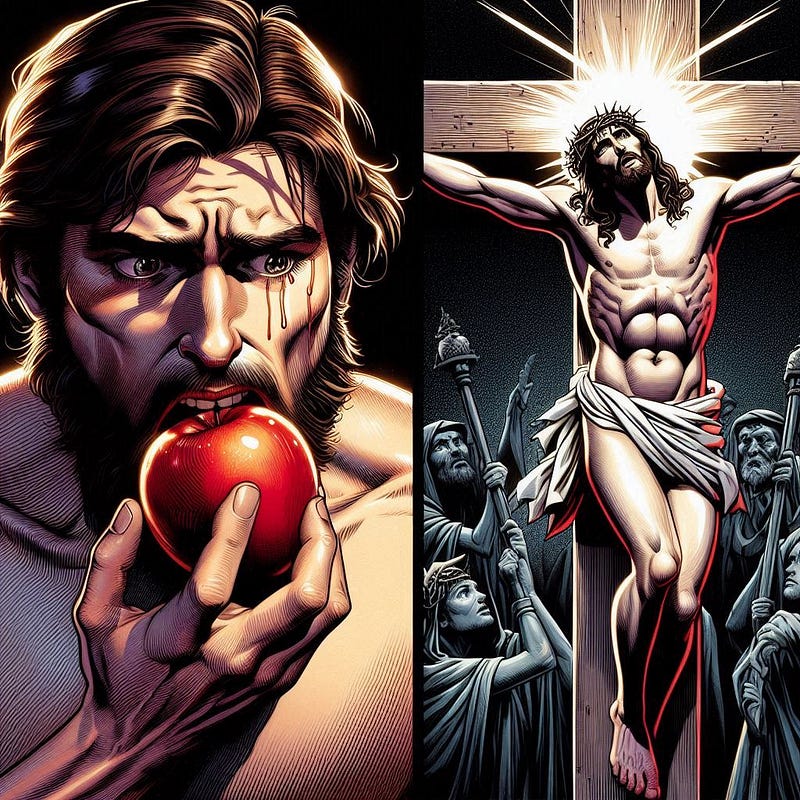
Romans 5:18 deals with the essence of both terms in the context of the Cross of Christ, the center of the Christian faith.
Consequently, just as one trespass resulted in condemnation for all people, so also one righteous act resulted in justification and life for all people. [Romans 5:18]
Paul is writing about the sin of Adam (the “trespass”) and contrasting it with Christ’s sacrifice on the Cross (the “righteous act”). And he says that this righteous act results in “justification” and life for all.
We know from the text that righteousness and justification are closely linked. Here’s how it works.
Righteousness = Right Standing
Both righteousness and justification deal with being in a state of good standing before God.
To be righteous means to align with God’s perfect standards of what is right and virtuous and good.
“Righteousness” is a noun in Greek. The word is dikaiosuné.
To have dikaiosuné is to have a character that is righteous. Such a person has virtue and has the approval of God.
In the Sermon on the Mount, Jesus declared those who desire righteousness to be blessed.
Blessed are those who hunger and thirst for righteousness, for they will be filled. [Mathew 5:6]

Jesus, it seems, is saying that if we consistently act with virtue, we’ll have the approval of God.
But that’s harder than we might think.
In fact, it’s later in that same chapter that Jesus says it’s impossible to always act with righteousness. On our own, we can never live up to the perfect standard.
For I tell you that unless your righteousness surpasses that of the Pharisees and the teachers of the law, you will certainly not enter the kingdom of heaven. [Mathew 5:20]
The Apostle Paul admits to the same reality. When he’s operating under his own power, he says he might know what he wants to do but is incapable of always doing it.
…For I have the desire to do what is good, but I cannot carry it out. For I do not do the good I want to do, but the evil I do not want to do — this I keep on doing. [Romans 7: 18–19]
And that’s a problem.
Because if God is perfectly holy and righteous how can we hope to have His approval?

We’ll be weighed in the balances and always find wanting.
That’s why we need to be justified by something outside of ourselves.
What Does Justified Mean?
“Justified” comes from the Greek word dikaioó.
It’s not a noun but a verb. To justify means to “make righteous.” Other related concepts include being set free and vindicated. To be acquitted.
Justified is an action. But it’s not our action.
We are made righteous by the actions of another and the faith that we have. The Christian is justified not by his or her own record, but by what Jesus has done. It is through His life, death, and resurrection that we are offered a way back into relationship with God.
The righteousness of Christ becomes our very righteousness through faith.
Here’s how Paul puts it in Romans 5.
Therefore, since we have been justified through faith, we have peace with God through our Lord Jesus Christ…[Romans 5:1]
We are justified, made righteous, before God by placing our hope and trust in Jesus.
The Bible says Jesus is the only way to have peace with God. To quiet that voice inside that otherwise condemns us if we’re failing to live up to our standards, or that is tempted to make us proud if we think we’re making the grade.
Fighting against both narratives of that voice was a theme for much of my early adult life.
A Practical Example of Failed Righteousness
Here’s how righteousness and justification worked for me in my prior corporate life as an ambitious “achiever.”
Like all of us, I desired approval. Right standing. Acceptability. Righteousness.
Did I have it? That was always in question.
When I looked in the mirror, did I find someone looking back who “deserved” to feel approved?

To answer that question, I needed to look at my sources of justification. When I put myself “on trial” to see if life was ok, was the verification sufficient to corroborate my claim of righteousness?
What did the evidence have to say about things like:
- My current career trajectory
- Bank account
- Retirement plan progress
Sometimes the verdict seemed to go in my favor. I would feel proud. I wanted to still appear humble but was self-satisfied that I was living up to my standards.
Sometimes the verdict seemed to go the other way. I would feel devastated. Crushed. Even more motivated to work and prove that I was worthy.
It’s no wonder that my career was the most important thing in my life.
But it was an argument I could never win.
Because my justification was only as good as my last performance review. It was never secure. Always in doubt.

I was desperate for the sense of peace and rest that comes from earning righteousness. Sometimes I thought I had made it. Hearing about a new promotion would feel wonderful … for a day.
But by the next day, it was back to the grind of earning. Seeking the temporary relief that might come from the next opportunity.
Ironically, I thought I was a committed Christian at this time. But I now see that this is what it looks like to live a life desiring a righteousness outside of Christ.
To honor God with my lips but to have a heart that was far from Him. To always be searching and never satisfied.
Bad News and Good News About Righteousness
In Romans 3, Paul brings sobering news for strivers like me.
Despite our best efforts, we are never going to achieve a lasting level of righteousness. We’re never going to be able to rest secure. He writes in Romans 3:10, “there is no one righteous, not even one.”
It’s the same story that Isaiah tells about striving to be justified in our own power.
All of us have become like one who is unclean,
and all our righteous acts are like filthy rags;
we all shrivel up like a leaf,
and like the wind our sins sweep us away. [Isaiah 64:6]
Even if we do our best to be a “good person” and follow every rule in the Bible, we’re going to fail. Even when we may try to do good, our motives are impure. Deep down we are selfish.

Because we’re aiming for the wrong thing.
Instead of looking for approval within ourselves or in another person, true righteousness is only found in God.
The Good News
The good news is we can fix our eyes on Someone besides ourselves.
We can wrestle with the shockingly good reality that we were never intended to earn our own approval. And we can believe it, because this is the story of the Bible.
Instead of striving (or despairing, if we think we’re too far gone), we can accept righteousness as a gift that comes from God.

Here’s how Paul puts it in Romans 3:
This righteousness is given through faith in Jesus Christ to all who believe. There is no difference between Jew and Gentile, for all have sinned and fall short of the glory of God, and all are justified freely by his grace through the redemption that came by Christ Jesus. [Romans 3: 22–24]
We don’t earn the gift. We receive the gift and learn to walk in grace and follow Him from that point onward.
We come to see ourselves as people who were truly captives that have been set free.

Jesus will not leave us where He finds us. Instead, He will change us into people who look more like Him as we follow Him.
For me, that has included walking away from my prior corporate ambitions.
This too is grace. As Christians we come to see that it’s not through our own power but only in Christ that we can do all things.
If you don’t know Jesus today, you should know this salvation is available “to all who believe.”
That’s regardless of your religious background. Independent of what deeds you’re ashamed of or tempted to be proud of. Unrelated to how you feel about your moral performance at all.
Because the life of the Christian is all about Jesus, the One who justifies us and makes us righteous in Him.
Salvation – Eternal Life in Less Than 150 Words
Please Comment – here or on Medium