


Excerpt: Covenantal language has always been a part of human society. A covenant is an agreement made between a party and a counter party. The two parties make a commitment to each other and agree that certain activities will (or will…
Covenantal language has always been a part of human society.
A covenant is an agreement made between a party and a counter party.
The two parties make a commitment to each other and agree that certain activities will (or will not) be done.
It’s a promise of fidelity.
Examples of Covenants
A mortgage loan is a covenant between a lending institution and a homeowner.
A bond is a financial instrument that contains covenants. It’s made between the issuer and a bondholder with covenants that spell out the terms and conditions of the bond.
Marriage vows can be considered a covenant. A covenant that signifies a lifelong commitment for better or worse.
There are also religious covenants. The Bible outlines four big ones¹ in the Old Testament that govern the relationship between God and His people at various points.
We’ll get to those, but first we should note one of the unpleasant elements of covenants:
Broken Promises
Covenants are promises. We live in a broken world, and broken promises are, sadly, part of life in such a world.
So covenants contain provisions that detail what happens when a covenant is breached.
Miss a payment on your mortgage? You’ll likely incur late fees. Miss too many and you’ll face losing your house to the bank.

Did the bond issuer fail to make promised interest payments? Depending on whether bonds are secured or unsecured, the bondholder may have legal claims against company collateral. The bond issuer may face bankruptcy.
Get divorced? Without a prenuptial agreement, assets will be divided up and conversations about spousal and child support get rolling. There’s a reason the US market for family law and divorce lawyers is estimated to be $13.1 billion in 2025.
Covenants provide blessings when they are kept and promise the opposite when they are violated. That’s also true for the covenants we see in the Old Testament.
Let’s take a look at them.
The Covenant with Noah
God establishes His covenant with Noah following the great flood.
The flood was caused by the rampant and unrestrained evil throughout the earth. The wickedness was so extreme that the Bible says God regretted having made humanity (Genesis 6:6).
The flood is a both a catastrophic event and a chance for a fresh start.
And after the dry ground re-emerges, God promises to never again destroy the earth with a flood.
8 Then God said to Noah and to his sons with him: 9 “I now establish my covenant with you and with your descendants after you 10 and with every living creature that was with you — the birds, the livestock and all the wild animals, all those that came out of the ark with you — every living creature on earth. 11 I establish my covenant with you: Never again will all life be destroyed by the waters of a flood; never again will there be a flood to destroy the earth.” [Genesis 9: 8–11]
God says the rainbow will be a sign of His promise.

What does Noah have to do as the counterparty?
Nothing.
God makes a unilateral promise. He holds Himself accountable without any commitment from Noah.
The Covenant with Abraham
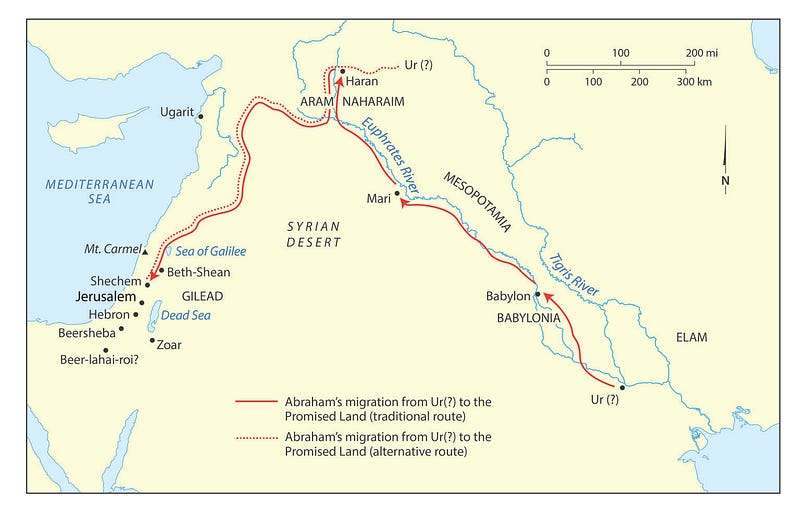
After the days of Noah, God makes a covenant with Abraham.
This is what God promises He will do:
“I will make you into a great nation,
 and I will bless you;
I will make your name great,
 and you will be a blessing.
3 I will bless those who bless you,
 and whoever curses you I will curse;
and all peoples on earth
 will be blessed through you.” [Genesis 12: 2–3]
Abraham’s end of the bargain is to follow God.
Abraham follows when God tells him to leave his homeland (Genesis 12:1). God promises him descendants and promises that those descendants will one day inherit the land of Canaan.
Short version: Trust God and you will be blessed.
God also requires a visible sign for all of Abraham’s male descendants as a sign of the covenant. The sign is circumcision.
9 Then God said to Abraham, “As for you, you must keep my covenant, you and your descendants after you for the generations to come. 10 This is my covenant with you and your descendants after you, the covenant you are to keep: Every male among you shall be circumcised.” [Genesis 17: 9–10]
The Covenant with Moses
Abraham’s son Isaac gives birth to Jacob.
God changes Jacob’s name to Israel in Genesis 33:28. And Jacob and his sons ultimately move from Canaan to Egypt where they grow into a substantial people group.
These “Israelite” descendants fall into slavery at the hands of the Egyptians. And they are eventually being led out of slavery by Moses, as recounted in the book of Exodus.
God establishes a covenant with these former slaves.
It is this “Mosaic” Covenant that forms the basis of Israelite worship of Yahweh in the Old Testament. It is what the New Testament refers to as the “Old Covenant.”
The elements include the giving of the Law on Mt. Sinai (the 10 Commandments), the religious practices and rituals detailed in Leviticus, and the promises of blessings for obedience and corresponding curses for disobedience in Deuteronomy 28.
Short version: Show faith in God by obeying the Law and thereby representing God to all the people of the world. Do this faithfully and be blessed. Lose faith in God and experience the opposite.
This is all outlined before the people from Egypt see the fulfillment of the covenant made with Abraham to inherit the land of Canaan.
The Davidic Covenant
After 40 years of wandering in the wilderness, the Israelites do indeed take possession of Canaan.
They decide they want a king to rule over them. God raises up David to follow King Saul (who was not faithful) and establishes a covenant with him.
We see it in 2 Samuel 7. It’s a covenant that points to David’s son Solomon and also points far ahead to Jesus. The capstone is a promise that the line of David will endure forever.
Your house and your kingdom will endure forever before me; your throne will be established forever.’” [2 Samuel 7: 16]
This is one reason the human genealogy of Jesus is important to Christians.
He must be descended from David, as indeed He is. And there are other promises that begin to emerge about a future “Messiah” who will bring liberation.
Messianic language in the Bible exists before the time of David, but it’s with the beginning of the Davidic Covenant that it intensifies.
Some of that prophetic language comes from David himself.
Like in Psalm 16:10 that anticipates the resurrection. And Psalm 22 that tells of a Messiah abandoned, pierced, and scorned, Who will nonetheless not be defeated.
Other language comes from the prophets like Isaiah (the Messiah will be born of virgin, the Messiah will be one who suffers in our place, the Messiah will come to set the captives free) and Zechariah (the Messiah will come riding on a donkey). Not to mention Daniel, Hosea, and others.
The New Covenant
In the book of Jeremiah, God promises that He will be making a new covenant that will be very different from the others.
31 “The days are coming,” declares the Lord,
 “when I will make a new covenant
with the people of Israel
 and with the people of Judah.
32 It will not be like the covenant
 I made with their ancestors
when I took them by the hand
 to lead them out of Egypt,
because they broke my covenant,
 though I was a husband to them,”
declares the Lord.
33 “This is the covenant I will make with the people of Israel
 after that time,” declares the Lord.
“I will put my law in their minds
 and write it on their hearts.
I will be their God,
 and they will be my people. [Jeremiah 31: 31–34]
This New Covenant is made possible through the life, death, and resurrection of Jesus.
Jesus inaugurated the celebration of the New Covenant at the Last Supper, when He talked to His disciples about the holy and mysterious significance of the meal they were sharing with him.

In the same way, after the supper he took the cup, saying, “This cup is the new covenant in my blood, which is poured out for you.” [Luke 22:20]
Because of this New Covenant, the Christian faith is not based on following external rules, but on a relationship.
We’re not trying in vain to hold up our end of a bargain with God that we’ll never be able to perfectly sustain.
Instead, we are offered a living relationship with God Himself. All made possible and mediated by Jesus, who sustains us.
Thank you, Jesus.
***********
1: Sourced with the help of https://bibleproject.com/articles/covenants-the-backbone-bible/.
For more reading on Biblical covenants this is another great resource: https://www.gotquestions.org/Bible-covenants.html.
Salvation – Eternal Life in Less Than 150 Words
Please Read/Respond to Comments – on Medium