


The Bible is clear that God demands His people worship only Him. The Ten Commandments begin with this straightforward directive:
“You shall have no other gods before me. [Exodus 20:3]
And the second proceeds in a similar manner.
“You shall not make for yourself an image in the form of anything in heaven above or on the earth beneath or in the waters below.” [Exodus 20:4]
The Israelites were busy violating both of those commandments while Moses was coming down from Mount Sinai carrying the two stone tablets.
Not a great start.
Moses had been up on the mountain for 40 days and nights and the Israelites figured he wasn’t coming back. They were ready to call in the replacement gods.
When the people saw that Moses was so long in coming down from the mountain, they gathered around Aaron and said, “Come, make us gods who will go before us. As for this fellow Moses who brought us up out of Egypt, we don’t know what has happened to him.” [Exodus 32:1]
So Aaron takes their gold earrings, melts them down, and fashions a cast calf from the metal. And just like that, the people have a golden calf to worship as their god.
But are false gods like the golden calf merely representative of humanity’s desperate desire to worship something? To carve and create their own graven images so they have something to petition when Yahweh doesn’t seem to be answering?
In certain places, the Bible seems to suggest that idols are only empty hunks of metal and wood. They are “worthless” and can offer “nothing.” That’s the sentiment we see here in Isaiah.
All who make idols are nothing, and the things they treasure are worthless. Those who would speak up for them are blind; they are ignorant, to their own shame. Who shapes a god and casts an idol, which can profit nothing? [Isaiah 44: 9–10]
But as we read through more of the Scripture we see there are real supernatural forces that hide behind those idols.
False gods = Demons
Deuteronomy, chapter 32, uses parallel language to link “strange gods” with “demons that are no gods.”
They stirred him to jealousy with strange gods; with abominations they provoked him to anger. They sacrificed to demons that were no gods,
 to gods they had never known, to new gods that had come recently,
 whom your fathers had never dreaded. [Deuteronomy 32: 16–17]
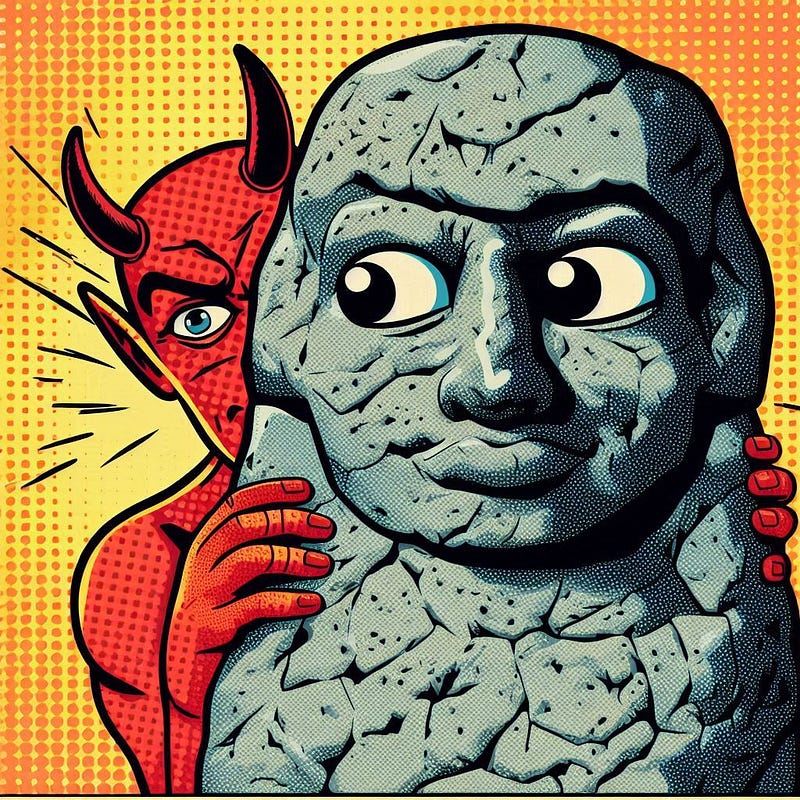
Paul confirms this supernatural reality over 1,000 years later in his first letter to the church at Corinth when he addresses food offered to idols.
20 No, but the sacrifices of pagans are offered to demons, not to God, and I do not want you to be participants with demons. 21 You cannot drink the cup of the Lord and the cup of demons too; you cannot have a part in both the Lord’s table and the table of demons. [1 Corinthians 10:20–21]
The Bible mentions the names of twenty-three different pagan gods. The clear implication is that there were malevolent spiritual forces behind each one.
This includes Philistine gods like Dagon (Judges 16:23), Canaanite gods like Baal and Asherah (1 Kings 15:13), Mesopotamian gods like Marduk (Jeremiah 50:2) and Tammuz (Ezekiel 8:14), the Greek god Zeus (Acts 14:13), and many others.
If we follow this thread, we get into discussion of the divine council and also speculation about what happened to the spirits of the Nephilim. And while those are interesting questions, they aren’t the focus of this article.
And that shouldn’t be our focus here anyway, since Isaiah makes clear that these idols / demons can “profit nothing.”
Do All Christians Believe False gods are Demons?
It might not get regular play in the sermon rotation of many pastors today, but yes, this is the orthodox Christian position.
Early church fathers like Justin Martyr and Tertullian addressed this in their writing.
Here’s Justin Martyr (100–165 AD), writing on the “Folly of idol worship” in The First Apology.

And neither do we honour with many sacrifices and garlands of flowers such deities as men have formed and set in shrines and called gods; since we see that these are soulless and dead, and have not the form of God (for we do not consider that God has such a form as some say that they imitate to His honour), but have the names and forms of those wicked demons which have appeared. [Justin Martyr, Chapter 9, The First Apology]
And here’s what Tertullian (born ~155 AD, died 220 AD) had to say about idols and demons in On Idolatry.

Thus it comes to pass, that in idolatry all crimes are detected, and in all crimes idolatry. Even otherwise, since all faults savour of opposition to God, and there is nothing which savours of opposition to God which is not assigned to demons and unclean spirits, whose property idols are; doubtless, whoever commits a fault is chargeable with idolatry, for he does that which pertains to the proprietors of idols. [Tertullian, Chapter 1, On Idolatry]
This is still the position today of both Protestant believers and Roman Catholics.
This is how the Protestant and evangelical organization gotquestions.org links false gods and evil spirits.
A desire to have supernatural contact with the “spirit world” often focuses people on supernatural power apart from the power God offers through a relationship with Jesus Christ and His Holy Spirit. The devil desires to be worshiped (Matthew 4:9), and demons teach false doctrine in order to deceive (1 Timothy 4:1). Those who worship false gods are, wittingly or unwittingly, pledging their allegiance to evil spirits who desire to usurp God’s rightful place in our hearts. [source, gotquestions.org]
Catholics hold to the same position.
In the same way the Greeks and Romans may have worshipped their divinities, fondly believing them to be good. But the Christian Scriptures declare that all the gods of the Gentiles are demons. [source, catholic.com]
Worshipping Idols or God?
The Christian view is that there is a real and active supernatural world that exists alongside the world we can see.
This can be a hidden supernatural reality since we don’t see many statues of graven images hanging around. Yet, our culture tends to worship the very same things that those ancient gods and goddesses represented.
- Idol worship at the temples of Aphrodite and Astarte may be down, but the worship of sex is as high as ever.
- The temple of Marduk isn’t receiving regular visitors, but the worship of individual success and acclaim is still trending up.
- There isn’t much visible worship of Baal these days, but many humans are still willing to sacrifice everything for money and power.
Reflecting on this reality helps me see the goodness and wisdom of the Bible in a new way. It’s full of warnings to avoid idol worship.

God hates idolatry because it takes glory away from Him, the place it rightfully belongs as our Creator and Good Father.
And He also knows that it will ruin us if we worship anything other than Him.
It’s what was at work when John D. Rockefeller, the richest man on earth at the time, told a reporter that he wanted “just a little bit more.” We’ll never be satisfied when worshipping at the altars of the false gods.
Instead, keeping our eyes fixed on the only One who is worthy is the Christian path to abundant life in this world and to the life in the world to come.
We know that we are children of God, and that the whole world is under the control of the evil one. We know also that the Son of God has come and has given us understanding, so that we may know him who is true. And we are in him who is true by being in his Son Jesus Christ. He is the true God and eternal life.
Dear children, keep yourselves from idols. [1 John, 5:19–21]
Salvation – Eternal Life in Less Than 150 Words
Please Read/Respond to Comments – on Medium
